Note 04
Lot identity: what gets captured at the point of recovery
A lot's identity has to be created where the material is first handled, because everything downstream can only ever be a copy of that first capture.
What is a lot?
A lot is the smallest quantity of material the enterprise is prepared to describe as one thing. It is the unit that carries a grade, a weight and a history.
Choosing the size of a lot is a real decision. Too large, and the grade becomes an average that describes none of the material accurately, and one bad sack contaminates the description of many good ones. Too small, and the record-keeping burden overwhelms the operation and the discipline collapses within a fortnight. The workable answer is usually the quantity that is recovered, screened and bagged as a continuous piece of work by one group of people in one session, because that is the natural boundary at which conditions actually change.
Once that boundary is set, the lot needs an identity. Not a description: an identifier. A short code that means this specific material and nothing else, assigned once and never reused.
What is captured, and when?
Seven things, at the moment the lot is closed.
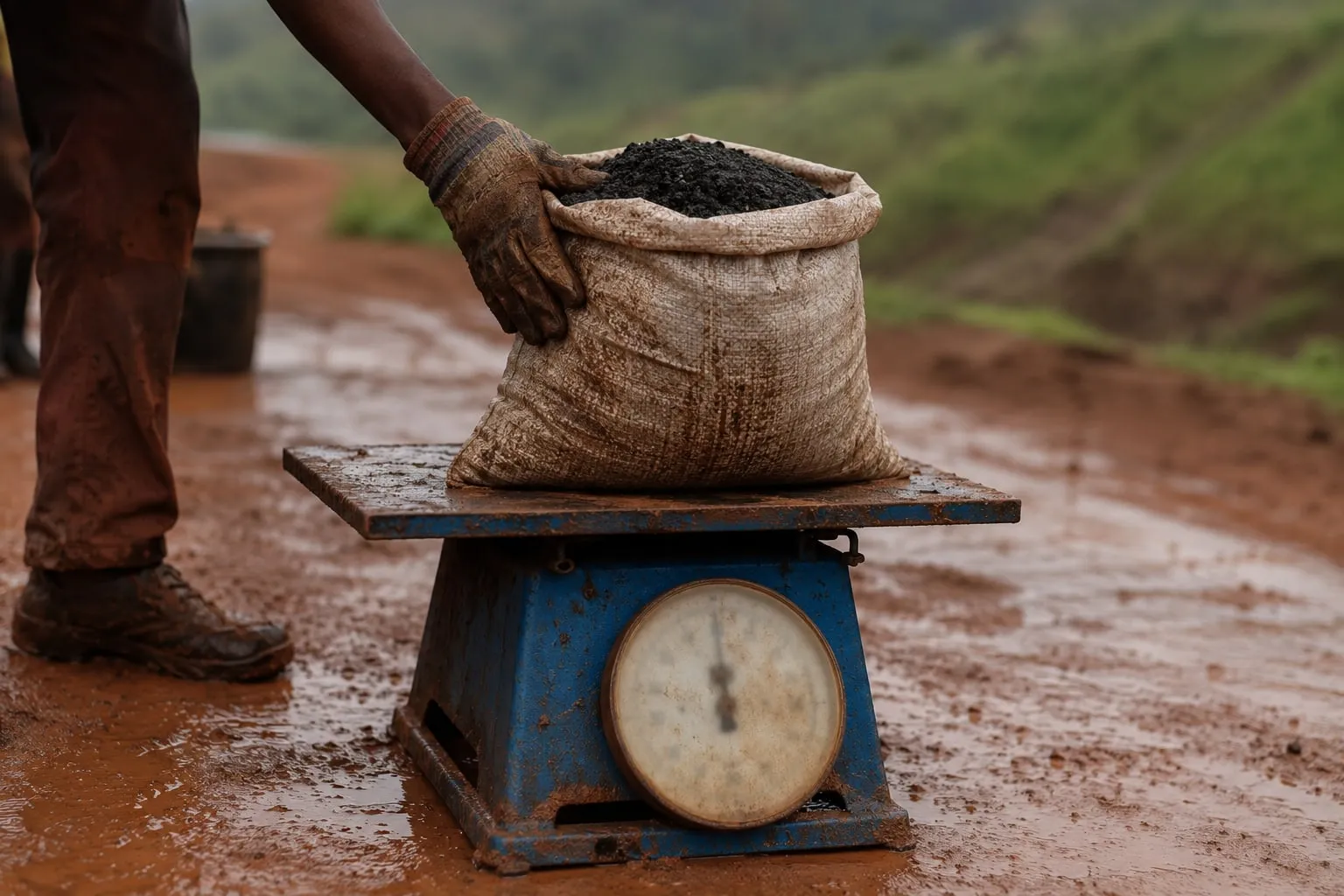
Weight. Recorded from the scale, in the presence of the person who recovered the material. Not estimated from the number of sacks, and not adjusted later to reconcile with a delivery note.
Grade. The size fraction and assessed composition, as determined by the grader who handled it.
Moisture. The condition at the point of weighing. On a wet day in this terrain, this is not a formality.
Photograph. The material and the filled, tagged lot as they actually were. A photograph is the cheapest form of corroboration available and the hardest to reconstruct afterwards.
Coordinates. Where the recovery happened. Not the name of a general area, which is what disputes are made of.
Handler. Who recovered it and who graded it, by name. This is the line that makes payment attributable and makes quality attributable.
Timestamp. When, to the minute, from the device rather than from someone’s recollection.
Together these turn a sack into a lot. Remove any one of them and something downstream becomes unprovable: without the handler you cannot pay correctly, without the timestamp and coordinates you cannot establish origin, without the photograph you have only assertions, without moisture you cannot defend the weight.
Why is nothing retyped later?
Because every transcription is an opportunity for the record to drift away from what happened, and drift is indistinguishable from dishonesty to anyone reviewing it afterwards.
Consider the ordinary chain in an undocumented operation. A figure is called out at the scale. Somebody writes it in a notebook. At the end of the week it is copied into a ledger. When a sale happens, it is copied again onto a delivery note. Perhaps it is later entered into a spreadsheet. That is four opportunities for a digit to change, and no way to tell afterwards which copy is the original.
Worse, the copies are usually reconciled. When the ledger does not agree with the delivery note, one of them is adjusted so that they agree, and the adjustment is not marked. The result is a set of documents that agree with each other perfectly and describe something that did not happen. This is the characteristic failure of hand-kept records, and it is why they are discounted.
The alternative is to capture once, at the point of recovery, and afterwards only ever reference. The delivery note does not restate the weight, it points at the lot. A correction is recorded as a correction, with its reason, alongside the original figure rather than instead of it.
Why capture in the field rather than the office?
Because the office version is a reconstruction, however honest the person writing it.
Field capture has to survive real conditions: rain, mud, gloves, poor connectivity, a scale that needs reading at an angle, and people who are being paid for recovery rather than for administration. Any system that assumes otherwise will be filled in later, which returns you to the reconstruction you were trying to avoid.
That constraint shapes what the capture can ask for. It has to be short enough to complete while the sack is on the scale. It has to work with no signal and reconcile when a signal returns. It has to be usable by someone whose hands are dirty and whose first language is not the language of the interface. Anything more elaborate than that is a system that works in a demonstration and not on a wet Tuesday.
What does the identity make possible?
Payment against a record. The handler is named on the lot, so the payment is calculable rather than negotiable. This is the change that matters most to the person doing the recovery, and it is covered in what changes for one woman.
A defensible consignment. A delivery becomes a set of named lots rather than a truckload. If a buyer queries one part of a load, the query resolves to specific lots with specific origins, and the rest of the consignment is unaffected.
Reconciliation. Despatched weight against received weight, per lot. Persistent differences become visible as a pattern rather than as a series of individually forgettable disappointments.
A history that accumulates. After a year, the record shows what was recovered, from where, by whom, at what grades, with what variation. That is the operating history an assessor, a lender or a buyer asks for, and it cannot be created retrospectively. It can only be accumulated.
Where this enterprise currently stands
Lot capture as described here is what we are building, with Lolwe AI providing the traceability infrastructure. It is the mechanism by which the enterprise intends to answer the questions in why an industrial buyer needs a record.
We are not claiming a long history of records kept this way. The enterprise does not yet have a continuous documented operating history, and we say so plainly on what we cannot yet show. A note describing good practice is not a claim to have practised it for years.
The lot-size boundary itself is one of the things the pilot is for. Choosing it is a judgement about where conditions actually change in practice, and that is learned from doing the work with records attached rather than decided in advance. We would rather set it from evidence than publish a figure now and quietly revise it later.
The short version
A lot is the smallest quantity the enterprise will describe as one thing, and it needs an identifier rather than a description. Weight, grade, moisture, photograph, coordinates, handler and timestamp are captured once, where the material is first handled. Everything afterwards references that capture instead of restating it, because a record that is copied and reconciled proves nothing.