05 — Supply
For buyers
What we supply, how it is described, what evidence travels with it, and what we cannot yet provide. If you assess suppliers for a living, the last of those is the one worth reading.
- Material
- Mineral byproduct and processing residue, recovered in the Kisii–Nyamira belt
- Form supplied
- Screened, in size fractions, bagged and lot-identified
- Reference route
- Cement manufacture. No offtake contract is in place
- Location
- Manga, Nyamira County, Kenya
What we supply
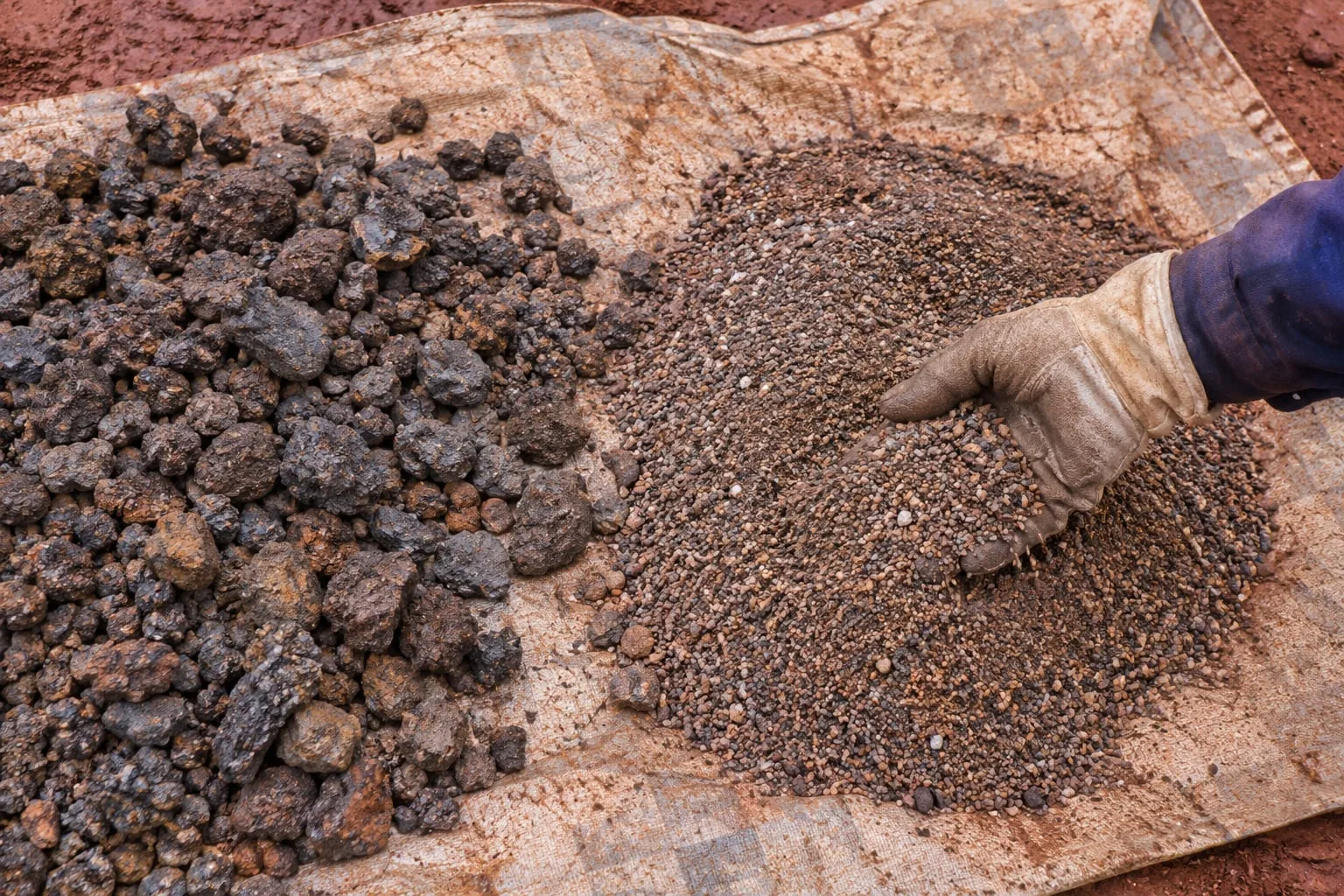
Mineral byproduct and processing residue recovered from stockpiles and working ground in the Kisii–Nyamira belt in western Kenya. The material has already been through a process and was not that process's intended product. We supply it screened into size fractions, bagged, and identified as lots. The material describes it in full.
We describe it as mineral byproduct rather than waste. That is a statement about classification and not a matter of presentation, and its classification under Kenyan environmental and mining regulation has not been formally determined. If your compliance function needs that determination before an agreement, say so early. We would rather have the conversation before a trial than after one.
How it is graded
Screening and assessment are carried out at the recovery sites by the women associated with the enterprise. The judgement being exercised is about representativeness rather than about size: a grade is a claim that holds for the whole lot, and the difficulty lies in sampling a segregating material so that it does.
Increments are taken from multiple points rather than grabbed from the surface, composited, and reduced by halving rather than by scooping. A split is retained, which is what allows a disagreement between your analysis and ours to be resolved technically rather than by whose word carries further. What grading actually is sets out the method.
| Property | Status | Position |
|---|---|---|
| Size fraction | Not yet cleared Not yet cleared: a stated gap. | Material is screened into fractions using hand screens at the recovery site. The screen apertures and the fractions we will offer are being established during the pilot. We are not publishing a fraction we cannot yet produce consistently. |
| Composition | To be evidenced To be evidenced: asserted in good faith, record not yet assembled. | Assessed by experienced physical inspection against known local formations. Laboratory analysis arranged where a buyer requires it. |
| Moisture | To be evidenced To be evidenced: asserted in good faith, record not yet assembled. | Recorded at the point of weighing, with the sampling moment, and carried on the lot record. |
| Laboratory assay | Not yet cleared Not yet cleared: a stated gap. | No laboratory analysis is currently held. It would be arranged on request. |
| Tolerance | Not yet cleared Not yet cleared: a stated gap. | None is stated. A tolerance is a commercial commitment, and we will not publish one before the pilot shows what we can hold consistently. It is set with a buyer at specification stage, against a defined consequence outside the range. |
What travels with a consignment
An evidence pack is assembled from lot records rather than written at the point of sale. Its contents fall into four groups.
- Identity and origin
- Lot identifier, recovery coordinates, timestamp, and the named handler who recovered it.
- Right to the material
- The arrangement under which recovery took place at the site concerned. Not yet assembled into a reviewable form.
- Characterisation
- Size fraction, assessed composition, moisture at sampling, the sampling method used, and the retained sample split.
- Chain and handling
- Weights recorded at defined points, handlers between them, transport details, and despatch-to-receipt reconciliation per lot.
What we cannot yet provide
This is the part a purchasing officer should read first, and it is the reason it appears on a supplier-facing page rather than only in a disclosure appendix.
- No signed offtake contract exists. Our reference route for graded material is cement manufacture. That describes an industrial use the material is suited to. It does not describe a customer, and we do not name a manufacturer, because no agreement exists that would make naming one accurate.
- No licence, permit, authorisation or certification is held, of any kind. Our operating position is that registration as a business name is not authorisation, and we do not offer it as one.
- The lawful basis for access, recovery and dealing is not yet documented in a form you could review, and the material's classification has not been determined.
- There are no audited financial statements, and the enterprise is a business name registered under Cap 499, which has no legal personality separate from its proprietor.
The full list, with the work that would close each item, is on what we cannot yet show. We would rather you found it here than found it later.
How to proceed
The sequence that works is specification, then trial consignment, then acceptance, then terms. Tell us what your process needs the material to be, and we will tell you plainly whether we can meet it, including when the answer is that we cannot yet.
Contact
Start with the specification
Send the specification your process requires. Enquiries reach the proprietor directly.
- rachel@nyamirawomenminers.co.ke
- info@nyamirawomenminers.co.ke
- +254 722 923 413
- Manga · Nyamira County